Closing Functional Safety Assessment Findings: From Gap List to Compliant SIS
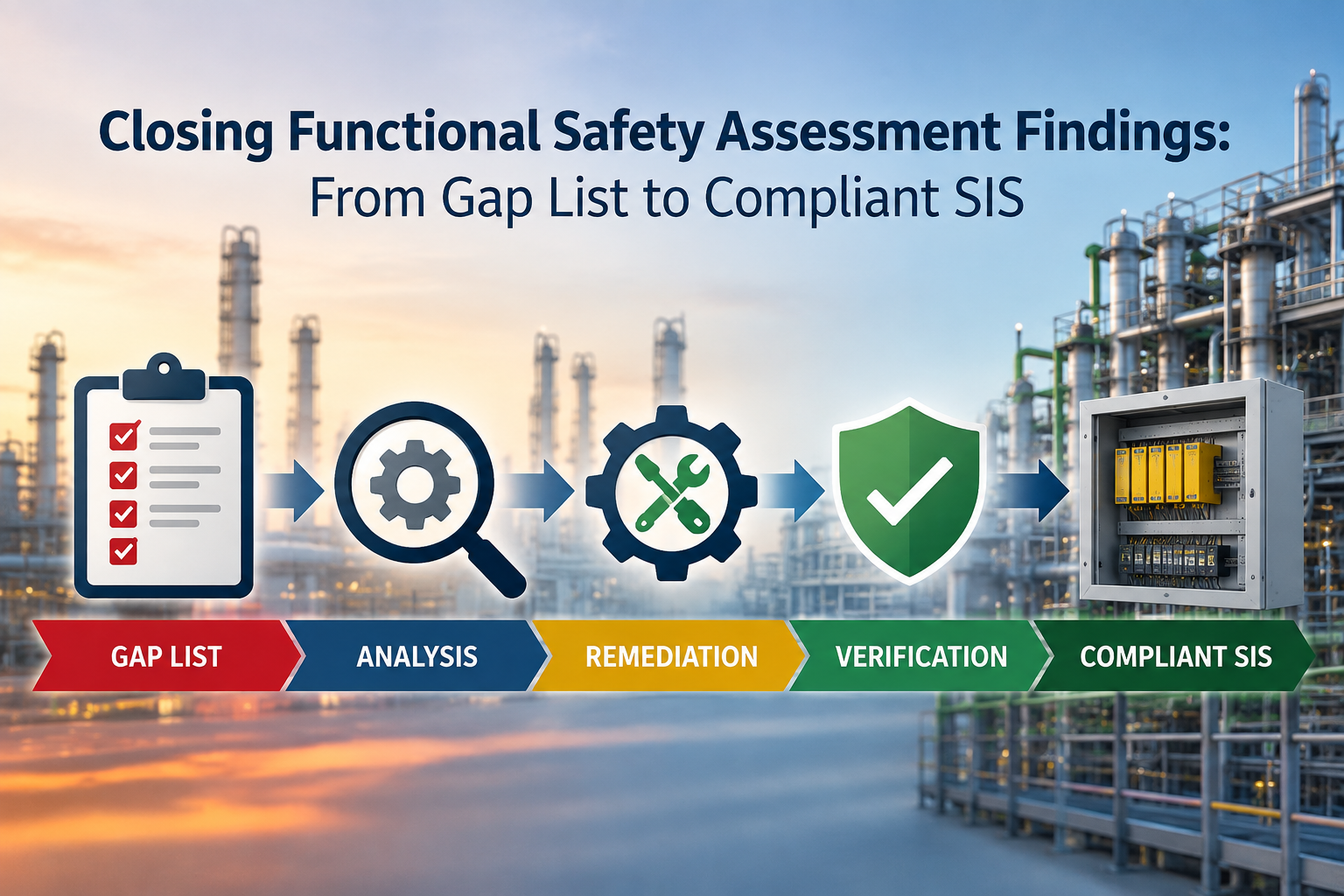
An assessment report is not the outcome. It is a list of gaps between what your safety instrumented system claims and what the evidence supports, and closing that list is where the actual work and the actual cost sit. Most organizations underestimate this stage because the findings look like documentation problems, when a meaningful proportion of them turn out to be engineering problems that documentation exposed.
This guide sets out how to work through findings in a defensible sequence. If you have not yet had the assessment, our guide to the five FSA stages covers what to expect.
Sort Findings by Type Before Prioritizing
Findings fall into three categories that require completely different responses, and treating them as one queue is the most common reason remediation programs stall.
|
Finding Type |
What It Means |
Typical Effort |
|
Documentation gap |
The work was done correctly but the evidence is missing or incomplete |
Days to weeks; often the fastest wins |
|
Traceability gap |
Documents exist but the chain from hazard to SIL claim is broken |
Weeks; may require re-running SIL determination |
|
Engineering gap |
The installed system does not achieve the claimed integrity |
Months; may require design change and a shutdown window |
Documentation gaps are worth closing first because they are cheap and they reduce the finding count quickly. But they should never be closed by writing documents that describe work which was not actually performed. Assessors look for that specifically, and a reconstructed record that cannot be corroborated is a worse position than an acknowledged gap.
Prioritize by Consequence, Not by Finding Severity
Assessment reports usually rank findings by their own severity scale. That scale reflects the seriousness of the compliance gap, not the process risk. A minor documentation finding on a safety function protecting against a toxic release matters more operationally than a major finding on a function protecting against a nuisance trip.
Re-rank the findings against the hazard scenarios behind each safety function before building the remediation plan. That ordering is what you will need to defend if a regulator asks why one finding was closed in three weeks and another is still open after a year.
|
The finding that most often turns out to be engineering SIL verification calculations that do not support the claimed target. It presents as a paperwork issue, since the calculation simply needs redoing. But when the recalculation shows the installed architecture cannot reach the target, the fix is added redundancy, a different device, or a shorter proof test interval. That is a design change with a shutdown window attached, and it is the finding most likely to blow the remediation schedule. |
The Closure Sequence
- Re-establish the hazard baseline. Where findings touch SIL targets, the hazard study has to be current first. A study that is out of date makes every downstream correction provisional. See when a HAZOP is required.
- Rebuild traceability. Each safety function needs a clean chain from hazard scenario through SIL determination to SRS. Our SIL assessment and determination guide covers the derivation.
- Correct the SRS. Most traceability findings resolve into SRS deficiencies, since the SRS is where the chain is supposed to be documented
. - Re-verify the design. Recalculate SIL verification with current failure data. This is where engineering gaps surface.
- Close validation evidence. Where commissioning records are missing, validation may need repeating. It cannot be reconstructed from memory.
- Fix proof testing. Intervals that do not match the SIL calculation, or procedures that do not test the full function, are common and straightforward to correct.
- Close competence records. Frequently the fastest finding to close and the most often left open.
Evidence Closure Properly
A finding is closed when the evidence exists, not when the action is complete. Each closure needs the corrected artefact, a record of what changed and why, and confirmation from someone competent and sufficiently independent that the gap is genuinely addressed.
Where closure required a change to the safety system, the change itself has to pass through management of change with impact assessment, which frequently triggers a further assessment of the affected lifecycle phase. Building that into the plan from the start avoids discovering it at the end. Ongoing governance of this sits within your functional safety management system.
Why Choose Arista Cyber
Arista Cyber delivers remediation across the full lifecycle, which matters because findings rarely stay in one discipline. A traceability finding usually needs SIL determination redone. A verification finding may need device selection revisited. A validation finding may need commissioning work repeated.
We can run the HAZOP, the SIL determination, the SRS, and the validation and verification as one sequenced program, so corrections trace cleanly rather than arriving as disconnected documents. And because our practitioners are TUV Rheinland certified, the competence evidence behind the remediation is itself defensible.
Next Steps
If you are holding an assessment report with open findings, the first step is sorting them by type and re-ranking by consequence. Explore our functional safety services, read our guide to functional safety standards, or contact the Arista Cyber team.
Common Questions
How long does it take to close a set of assessment findings?
Documentation findings close in days to weeks. Traceability findings typically take weeks and may require re-running SIL determination. Engineering findings run to months because they involve design change and usually a shutdown window. A realistic program for a facility with findings across all three categories is six to eighteen months.
Can we close documentation findings by writing the missing documents now?
Only where the underlying work was genuinely performed and can be corroborated. Producing a record describing work that did not happen is a materially worse position than an acknowledged open finding, and assessors examine this specifically. Where the work was not done, it needs doing.
Does closing findings require a new assessment?
Where closure involved a change to the safety instrumented system, the change passes through management of change and generally triggers assessment of the affected lifecycle phase. Pure documentation closures usually do not, but the assessor who raised the finding should confirm closure.
|
Holding an assessment report with open findings? Arista Cyber closes findings across the full lifecycle, from hazard study through validation, as one sequenced program. |
Facing tougher cyber security challenges?
Talk to Arista Cyber about your OT security posture.
Request a consultation