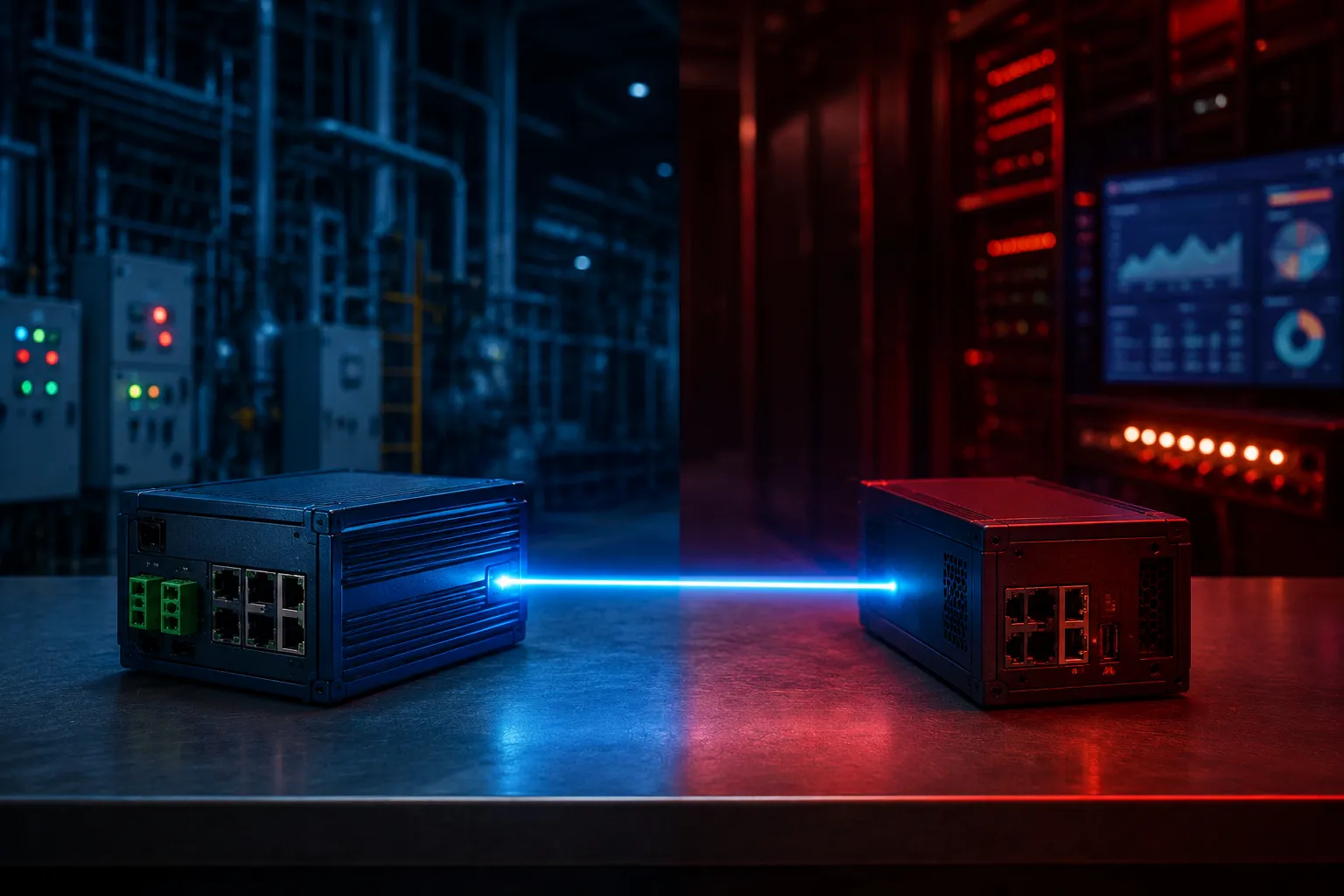
A firewall and a data diode both sit at a network boundary, and both are described as controlling what crosses it. That is where the similarity ends. A firewall permits traffic in both directions and uses software rules to decide what is allowed. A data diode permits traffic in one direction only, and the reverse path is absent from the hardware entirely.
For most IT boundaries a firewall is the correct control. For the boundaries around industrial control systems, where the consequence of an inbound compromise is measured in downtime, equipment damage, or personnel safety, the distinction between a filtered path and no path at all becomes decisive. This article sets out how each technology works, where each belongs, and why many industrial operators end up deploying both.
The Short Answer
A firewall reduces risk by inspecting traffic and applying rules. It is flexible, it supports two way communication, and it depends on those rules being correct and staying correct. A data diode reduces risk by making inbound traffic physically impossible. It is inflexible by design, supports one direction only, and does not depend on configuration at all.
Use a firewall where legitimate traffic needs to move both ways. Use a data diode where nothing should ever come back.
How a Firewall Protects a Boundary
A firewall inspects packets against a rule set and forwards or drops them accordingly. Modern next generation firewalls add deep packet inspection, application awareness, intrusion prevention, and in some cases industrial protocol decoding. Deployed and maintained well, a firewall is a capable and necessary control.
Its protection, however, rests on three assumptions: that the rules are written correctly, that they stay correct as the environment changes, and that the firewall software itself is free of exploitable vulnerabilities. Each of those assumptions is reasonable, and each has failed in real incidents. Rule sets accumulate exceptions over years of operation. Temporary permissions granted for a vendor become permanent. Firewall appliances themselves have been the subject of critical vulnerabilities that allowed attackers to bypass or take control of the device.
None of this makes firewalls a poor control. It makes them a control whose effectiveness depends on ongoing human accuracy.
How a Data Diode Protects a Boundary
A data diode takes a different approach. The device is constructed so that the components required to send data in the reverse direction are simply not present, typically by pairing an optical transmitter on one side with a photodetector on the other. Our article on what a data diode is and how it works explains the optical core and protocol break in more detail.
Because the reverse path does not exist in hardware, there is no rule to get wrong, no exception to accumulate, and no firmware flaw that can open a channel that was never built. The device also enforces a full protocol break, so the source and destination systems never establish a session with each other at any point. Attacks that depend on manipulating a live connection have nothing to manipulate.
|
The core distinction A firewall decides what traffic is allowed. A data diode decides what traffic is possible. One is a policy decision that can be changed; the other is a physical property that cannot. |
Data Diode vs Firewall: Direct Comparison
|
Attribute |
Firewall |
Data Diode |
|
Direction of flow |
Bidirectional, filtered by rules |
One direction only |
|
Enforcement mechanism |
Software and configuration |
Hardware, at the optical layer |
|
Inbound attack surface |
Present and managed by policy |
Physically eliminated |
|
Misconfiguration risk |
High; one rule error can open a path |
None; direction cannot be reconfigured |
|
Session behaviour |
End to end sessions permitted |
Full protocol break, no end to end session |
|
Vulnerable to device exploits |
Yes; firewall software is itself a target |
Reverse path absent regardless of software state |
|
Flexibility |
High; supports any traffic pattern |
Deliberately limited to one way flows |
|
Audit effort |
Ongoing rule review and documentation |
Direction demonstrable by design |
|
Best suited for |
IT boundaries needing two way traffic |
OT and ICS zones needing absolute isolation |
The Misconfiguration Problem
The single most important practical difference between the two technologies is what happens when someone makes a mistake.
Firewall rule sets in industrial environments are rarely simple. They accumulate over years, they are modified during outages and commissioning work under time pressure, and they are frequently maintained by teams who inherited them from predecessors. A rule added to support a vendor connection during a turnaround, intended to be temporary, quietly remains in place. An any to any exception introduced to resolve a production issue at three in the morning is never reviewed. None of this reflects poor engineering; it reflects the reality of operating a plant.
A data diode has no equivalent failure mode. There is no rule to add and no exception to leave in place. An engineer working under pressure at three in the morning cannot accidentally make a diode bidirectional, because the hardware to do so was never installed. For the boundaries protecting the most consequential systems in a facility, removing the possibility of human error is often worth more than the flexibility that is given up.
When a Firewall Is the Right Choice
A firewall remains the appropriate control wherever legitimate traffic genuinely needs to travel in both directions:
-
Enterprise IT network boundaries and internet edge
-
Segmentation between IT zones with two way application traffic
-
Environments requiring interactive remote access sessions, paired with multi factor authentication and session recording
-
Boundaries where inbound control commands or configuration changes are a legitimate operational requirement
-
Situations where inspection and alerting on inbound traffic is itself the security objective
When a Data Diode Is the Right Choice
A unidirectional gateway is the stronger control wherever the legitimate data flow is genuinely one way:
-
Exporting historian or process data from the control network to enterprise or cloud systems
-
Forwarding logs, alerts, and telemetry from OT to a security operations centre or SIEM
-
Sending data out from safety instrumented systems without exposing them to any inbound path
-
Monitoring remote and unmanned sites from a central operations centre
-
Replacing removable media transfers across an air gapped boundary
-
Any boundary where the operator has concluded that no inbound traffic is ever acceptable
Using Both: Defence in Depth
Framing this as a choice between two technologies is usually the wrong way to look at it. In a well designed industrial architecture the two controls sit at different boundaries and do different jobs.
A typical arrangement places firewalls at the enterprise boundary and between IT zones, where two way traffic is required and inspection adds value. The data diode is then deployed at the boundary that matters most, most often between the control network and everything above it, where the operator has determined that outbound data is necessary and inbound traffic is not.
This layering means an attacker who defeats a firewall rule set still arrives at a boundary that offers no route forward. That is a materially different security position from one where every boundary depends on configuration remaining correct.
The Compliance Argument
Under IEC 62443, conduits between zones must be protected to the higher of the two Security Levels they connect. Demonstrating that a firewall achieves Security Level 3 or Security Level 4 requires documenting rule sets, change control, review cycles, and continuing evidence that the configuration remains correct. Our IEC 62443 Compliance Playbook walks through the zone, conduit, and Security Level model in detail.
Demonstrating that a data diode achieves the same outcome is considerably more straightforward, because the property being evidenced is physical rather than procedural. Auditors are shown a device that cannot pass traffic inbound rather than a rule set that is asserted not to. For operators working toward the higher Security Levels, this reduction in evidential burden is a genuine and often underestimated benefit.
Frequently Asked Questions
Does a data diode replace our firewalls?
No. It replaces the firewall at boundaries where traffic should only ever flow one way. Boundaries that require two way communication still need a firewall. Most operators run both.
Can a next generation firewall be configured to be effectively one way?
A firewall can be configured to permit traffic in one direction only, but that is a policy decision recorded in software. It can be changed, it can be misconfigured, and it can potentially be bypassed if the firewall itself is compromised. A data diode does not rely on configuration for its directionality.
Is a data diode harder to operate than a firewall?
Day to day operation is generally simpler, because there is no rule set to maintain. The effort shifts to the initial deployment, particularly configuring the application proxies for the specific data flows and protocols in use at the site.
What happens if we later need traffic to flow the other way?
A data diode cannot be reversed in software. Some environments deploy a second diode facing the opposite direction for a separate, strictly defined flow, with each device remaining one way. If a boundary genuinely requires two way interaction, it should be protected by a firewall instead.
Next Steps
If you are still working through the fundamentals, start with our explanation of what a data diode is and how one way enforcement works.
If you have decided a diode is the right control for one of your boundaries, our data diode vendor buyer's guide covers the evaluation criteria that matter most, including certification level, protocol support, and throughput.
Arista Cyber supplies and supports the OWA data diode appliance range, with certified optical diode cores and connectors for the industrial systems already deployed in your plant.
|
Not sure which control belongs at which boundary? Talk to an Arista Cyber specialist about your OT network architecture. |