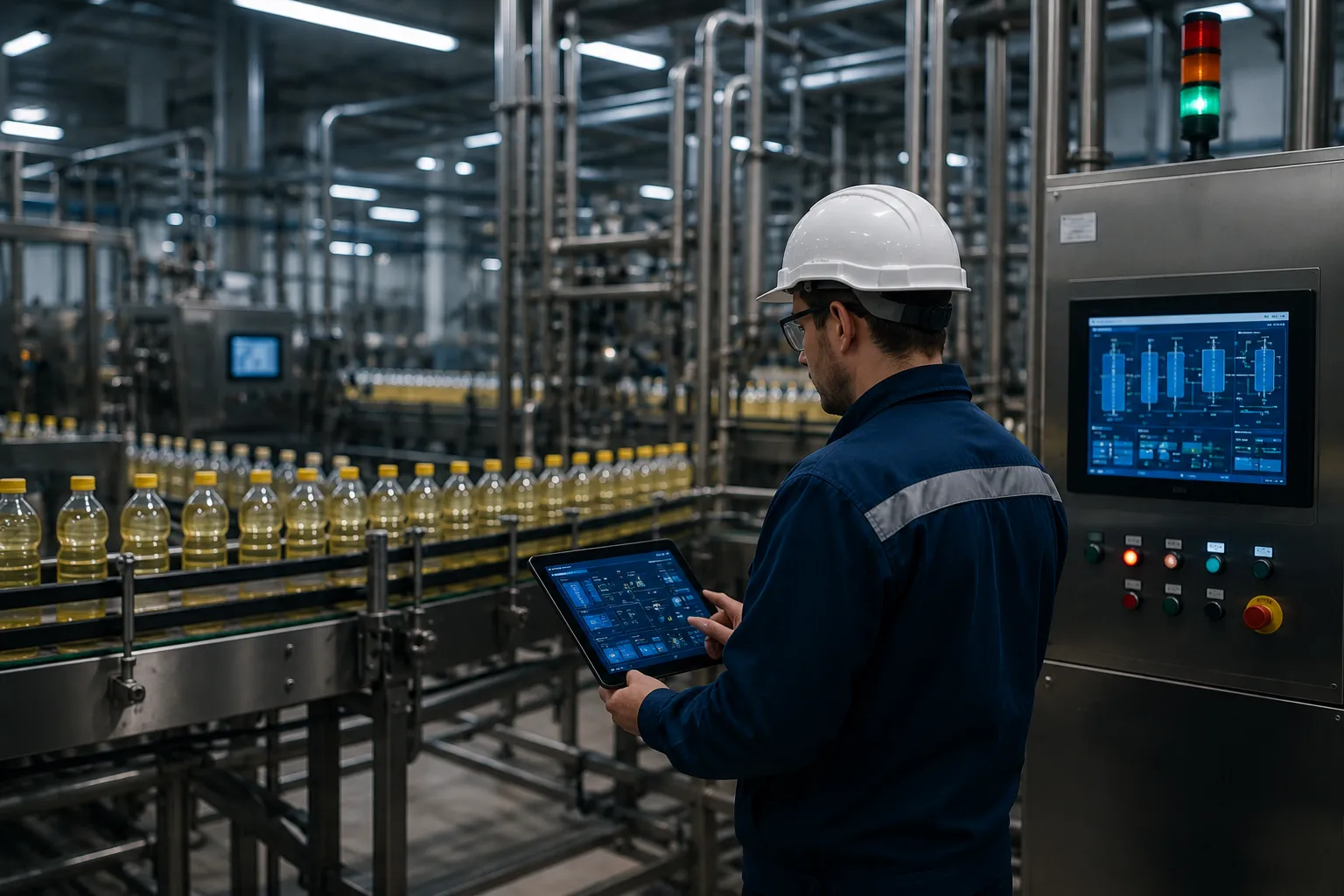
Food and beverage manufacturing sits at an unusual intersection: it combines the continuous production constraints of process industry with the high-frequency output demands of consumer goods manufacturing. A food processing line that runs 20 hours a day cannot be paused for patch maintenance during peak production. A beverage bottling facility with recipe-driven batching systems holds intellectual property in its process parameters that no one outside the organization should be able to read or modify.
In June 2021, JBS Foods, the world's largest meat processor, paid an $11 million ransom to the REvil group after a ransomware attack shut down processing facilities across the US, Canada, and Australia for several days. While JBS's production shutdown was driven by IT system impacts rather than direct OT compromise, it illustrated how completely modern food manufacturers depend on the integrity and availability of their production technology environment.
The JBS incident was not an isolated event. According to Dragos' 2025 Year in Review, food and beverage manufacturing ranked among the most targeted industrial sectors for ransomware in 2024. Understanding the specific ICS attack surface in food and beverage production, and the security architecture that protects it, is the starting point for any food sector OT security program.
Why Food and Beverage Manufacturing Has a Growing OT Security Problem
Food and beverage manufacturers have historically invested less in OT cybersecurity than oil and gas or utilities operators. Three factors are changing that quickly:
-
Industry 4.0 adoption: automated production lines, real-time quality monitoring, ERP integration with production systems, and IoT-enabled supply chain tracking have all increased the connectivity of food manufacturing OT environments. Each new connection is a potential attack pathway
-
Regulatory pressure: the FDA Food Safety Modernization Act (FSMA) and its preventive controls rules require manufacturers to assess and manage risks to food safety, a category that regulators have begun interpreting to include cybersecurity risks to process control systems
-
High ransom value: food manufacturers operate on tight margins and high volume. Production downtime is extremely costly, making ransom payment a financially rational option that threat actors exploit deliberately by timing attacks to peak production periods
The ICS Attack Surface in Food and Beverage Production
Continuous Production Line PLCs
The PLCs controlling filling, mixing, cooking, cooling, and packaging operations in a food facility run continuously during production shifts. They communicate with HMIs that operators use for line monitoring and adjustment. Like all PLCs in industrial environments, many food manufacturing PLCs were not designed with cybersecurity in mind and run on legacy firmware with no authentication on programming interfaces. An attacker who reaches the production network segment can potentially send commands directly to line PLCs.
Recipe and Formulation Systems
In beverage and processed food manufacturing, product recipes are stored in a combination of batch control systems, manufacturing execution systems (MES), and PLC parameter sets. Recipe data, which defines the exact composition, sequence, and parameters of every product, is high-value intellectual property. It is also a process control input: modifying recipe parameters in the batch control system modifies the actual product being manufactured. The integrity of recipe systems is both an IP protection matter and a product safety matter.
ERP and MES Integration Points
Modern food manufacturers integrate their production systems with ERP platforms for inventory management, order scheduling, and regulatory traceability reporting. These integrations create bidirectional data flows between the IT network and the OT network. Network segmentation that controls these integration points, typically through a DMZ with specific data exchange rules, is essential for preventing an IT network compromise from propagating into the production environment.
Cold Chain and Temperature Control Systems
Temperature control is critical for food safety in dairy, meat, seafood, and ready-to-eat manufacturing. Refrigeration systems, cold storage monitoring, and pasteurization controls are OT assets with direct food safety implications. Refrigeration system PLCs and environmental monitoring devices often receive less security attention than production line controls, despite managing conditions that directly affect the safety of food being produced.
Specific Threats to Food and Beverage OT Environments
Ransomware Targeting Production Systems
The primary near-term threat for food manufacturers is ransomware that disrupts production through IT system compromise, preventing access to production scheduling, quality reporting, and ERP systems that production depends on. The JBS Foods attack demonstrated this pathway. OT systems may not be directly encrypted, but production halts when the IT systems that communicate production orders, verify product quality, and manage regulatory compliance go offline.
The next step in this threat evolution is ransomware groups developing the OT knowledge to directly affect production systems. Ransomware groups have demonstrated OT capability in industrial environments in other sectors. Food manufacturers who have addressed their IT security but not their OT attack surface are building one half of a defense.
Product Contamination via Process Manipulation
Deliberately altering product formulation through unauthorized modification of recipe parameters or dosing system commands is a low-frequency but extreme-consequence threat. Control system integrity for recipe and dosing systems prevents unauthorized modification and provides the detection capability to identify changes before affected product reaches distribution. This is not a theoretical threat: product tampering with the intent to harm consumers has occurred through physical means; the cyber pathway is more difficult but not impossible for a determined attacker.
Supply Chain Attacks Through Vendor Access
Food manufacturers use multiple vendors for production line automation: line PLCs, packaging systems, quality inspection systems, and refrigeration controls. Each vendor may have remote access to their equipment. Vendor remote access that is poorly controlled creates multiple entry points into the production OT network. Supply chain attacks that use vendor software updates or vendor remote access as the attack pathway are one of the documented ICS attack vectors active against industrial operators.
Regulatory Context for Food Manufacturing OT Security
|
Regulation |
Requirement |
OT Security Implication |
|
FDA FSMA Preventive Controls for Human Food |
Identify and implement preventive controls for known or reasonably foreseeable hazards |
Cybersecurity risks to process control systems are increasingly recognized as preventive control scope |
|
FDA FSMA Supply Chain Program |
Supplier verification and hazard analysis for raw material and ingredient suppliers |
Vendor remote access to OT systems as a supply chain cybersecurity risk |
|
HACCP (Hazard Analysis Critical Control Points) |
Identify critical control points and implement monitoring procedures |
CCP monitoring systems (temperature, pH, pasteurization) are OT assets requiring integrity protection |
|
IEC 62443 |
OT security framework applicable to food manufacturing |
Zone and conduit architecture for production, quality, and utility OT networks; Security Level requirements for safety-critical process points |
OT Security Controls for Food and Beverage Manufacturers
-
Network segmentation between production line OT, quality systems, and ERP integration points — prevent IT network compromise from reaching production PLCs
-
Passive OT monitoring on production network segments — detect unauthorized device connections, unexpected protocol commands, and recipe parameter modifications outside of approved change windows
-
Recipe and parameter change management: formal authorization for any modification to product parameters stored in batch control systems or PLCs, with audit logging of all changes
-
Vendor remote access controls — MFA-enforced, session-recorded, least-privilege access for all production equipment vendors
-
OT hardening for production PLCs — default credential changes, unused port disabling, programming interface access restriction
-
OT backup and recovery for PLC programs and recipe libraries — tested restoration procedures for all production-critical control configurations
Frequently Asked Questions
Does FSMA require food manufacturers to address OT cybersecurity?
The FDA Food Safety Modernization Act preventive controls rules require food manufacturers to identify and implement controls for known or reasonably foreseeable hazards that could affect food safety. As cyber-physical attacks on food manufacturing control systems become more documented, regulators have begun to include cybersecurity risks within the scope of preventive controls analysis. While FSMA does not currently cite specific OT security standards, an OT security program aligned to IEC 62443 provides a defensible framework for demonstrating that cybersecurity risks have been assessed and controlled.
How does OT security in food manufacturing differ from pharmaceutical OT security?
Food and pharmaceutical manufacturing share many OT security characteristics: continuous production constraints, recipe and formulation IP protection, batch control systems, and strict regulatory oversight. The primary differences are the regulatory framework (FDA FSMA for food vs FDA 21 CFR Part 11 and IEC 62443 for pharma), the consequence profile (food safety vs patient safety), and the technology maturity (pharmaceutical OT environments have generally received more security investment due to earlier and stronger regulatory pressure). The OT cybersecurity in pharma guide covers the pharmaceutical-specific approach for comparison.
What was the actual OT impact of the JBS Foods ransomware attack?
The JBS attack primarily impacted IT systems: corporate networks, communication systems, and the business applications that production scheduling and reporting depended on. Production facilities shut down because they could not operate without these IT systems, not because the PLCs or production line controls were directly compromised. This distinction matters for OT security planning: the most near-term threat to food manufacturers is IT-to-OT dependency disruption rather than direct OT compromise. Addressing both the IT security posture and the OT dependency architecture is the complete defense.
What is the first OT security priority for a food manufacturer with no existing program?
The first priority is understanding the attack surface through an OT risk assessment. For food manufacturers specifically, the assessment should focus on three areas: the IT/OT integration points where a corporate IT compromise could reach production systems; the vendor remote access pathways for production line equipment; and the authentication state of production PLCs and batch control systems. These three areas represent the most likely initial attack pathways and the highest-consequence targets in a typical food manufacturing OT environment.
|
Ready to assess your OT security posture? We help industrial operators build practical OT security programs that account for operational and process safety constraints. Book a free consultation. |




.jpg)