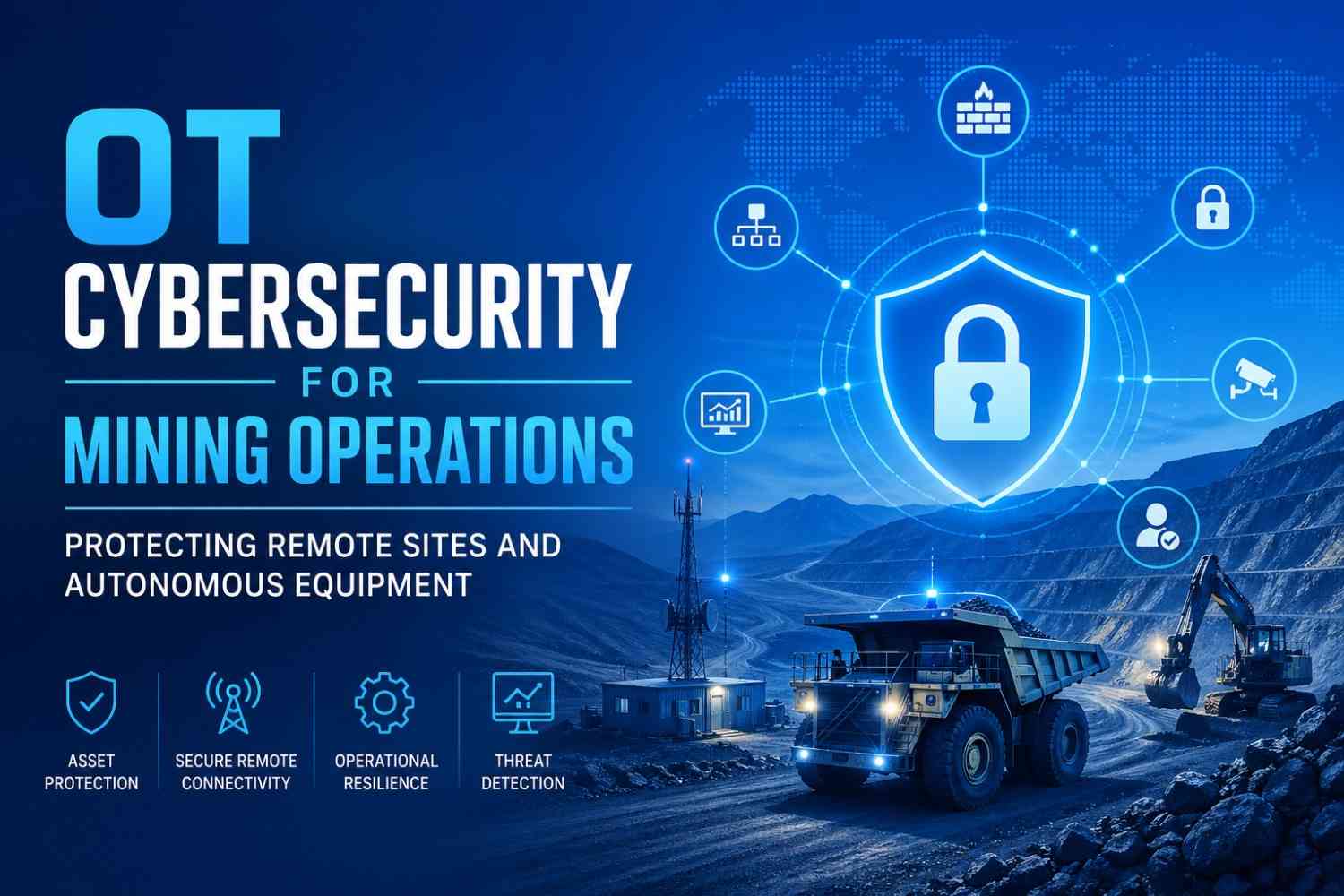
OT Cybersecurity for Mining Operations: Protecting Remote Sites and Autonomous Equipment
Mining operations have a distinctive OT security challenge that few other industrial sectors share: the operational technology that controls production - autonomous haul trucks, remote-operated drilling rigs, SCADA systems for mine dewatering and ventilation, and minerals processing plant control systems - is distributed across some of the most remote, physically inhospitable, and communications-constrained environments in the industrial world.
A mine site may be hundreds of kilometers from the nearest city, connected to corporate IT systems via satellite or microwave links with limited bandwidth, and operating autonomous equipment worth hundreds of millions of dollars that is controlled entirely through wireless networks. The same connectivity that enables remote operations and reduces the need for on-site personnel is the attack surface that adversaries can exploit.
This post explains the specific OT security challenges of mining operations, the attack vectors that are most active against the sector, and the security controls that protect mining OT within the operational and communications constraints of remote mine sites.
|
Mining was identified as a high-priority target sector for ransomware operators in 2024, with a 45% increase in confirmed incidents compared to 2023 The primary driver was the adoption of autonomous equipment and remote operations control systems that created new IT/OT connectivity pathways at mine sites previously characterized by isolated OT environments. Ransomware operators specifically targeted autonomous fleet management systems and minerals processing SCADA as the highest-value operational disruption points. Source: Dragos 2025 OT/ICS Cybersecurity Year in Review |
1. The Mining OT Environment: What Makes It Distinct
|
OT System |
Function in Mining Operations |
Security Challenge |
|---|---|---|
|
Autonomous Haulage Systems (AHS) |
Fleet management and control for autonomous haul trucks in open-pit mines |
Wireless network dependency; vehicle-level control access; production halt if compromised |
|
Drill and blast management systems |
Controls autonomous and semi-autonomous drilling equipment; manages blast planning and execution |
Safety-critical system; blast parameter manipulation could cause physical harm |
|
Mine ventilation control (underground) |
Manages fresh air supply, exhaust ventilation, and emergency fresh air systems in underground mines |
Direct personnel safety impact; ventilation failure in underground mines is a life safety emergency |
|
Mine dewatering SCADA |
Controls pumping systems that prevent underground workings from flooding |
Loss of dewatering control can cause rapid flooding of underground operations |
|
Minerals processing DCS |
Process control for crushing, grinding, flotation, and leaching circuits |
Continuous process with high throughput - downtime is directly measured in lost production value |
|
Remote Operations Centers (ROC) |
Centralized control of remote mine sites from urban operations centers |
Remote operations require robust, secure communications infrastructure; ROC compromise provides control over entire mine |
|
Fleet management and dispatch systems |
Coordinates equipment movements, production targets, and maintenance scheduling |
IT/OT boundary system; ransomware targeting fleet management disrupts production planning |
1.1 The Remote Site Communications Problem
Many mine sites rely on satellite communications links, terrestrial microwave networks, or cellular infrastructure for connectivity between the site and corporate IT systems, remote operations centers, and vendor support teams. These communication links have limited bandwidth, variable latency, and in some cases scheduled outage windows for maintenance. Security controls that depend on continuous high-bandwidth connectivity to central security infrastructure - cloud-based security platforms, centralized log aggregation, real-time threat intelligence feeds - do not function reliably in mining communications environments.
The security architecture for remote mine sites must account for the possibility of communications disruption. Security controls that continue to operate during communications outages - local network monitoring, offline anomaly detection, local authentication - are more appropriate for remote mining environments than controls that require continuous connectivity to operate.
1.2 Autonomous Equipment as OT Attack Surface
The adoption of autonomous haul trucks, autonomous drilling rigs, and remotely operated equipment in modern mining operations creates an OT attack surface that did not exist in manually operated mines. Each autonomous vehicle is a networked endpoint - it runs onboard computing systems, communicates with the fleet management system over a wireless network, receives navigation and task instructions from the automation platform, and in some implementations can be commanded remotely.
A compromised autonomous haul truck is not just a data security incident. A vehicle receiving false position data, incorrect task instructions, or manipulated navigation commands creates a physical safety risk. Autonomous equipment safety depends not only on the onboard safety systems of the vehicle but on the integrity of the communications and control systems that direct it.
2. The Active Threat Vectors in Mining OT
2.1 Ransomware Targeting Minerals Processing and Fleet Management
Minerals processing plants - with continuous production processes and throughput measured in thousands of tonnes per hour - face the same ransomware risk as other continuous process manufacturers, with the additional pressure of remote location and limited recovery resources. A ransomware incident that takes down the DCS of a remote minerals processing plant cannot be resolved by flying in a team of IT responders within hours. The recovery timeline is constrained by logistics, communications, and the availability of specialist OT expertise in geographically remote locations.
Fleet management systems, which sit at the IT/OT boundary and coordinate the autonomous equipment that moves ore from pit to processing plant, are a high-value ransomware target. Disrupting fleet management does not require reaching the autonomous vehicles themselves - encrypting the fleet management servers halts production scheduling and equipment coordination, bringing autonomous mining operations to a standstill.
2.2 Remote Operations Center as a Single Point of Compromise
Remote operations centers - increasingly used by major mining companies to operate multiple mine sites from a single urban location - concentrate the operational control of multiple sites in a single network environment. A compromise of the ROC network provides potential access to the OT environments of every mine site the ROC controls. The connectivity between the ROC and each mine site - the communication links that carry operational data and control commands - becomes an attack pathway from the ROC into site-level OT systems.
The security architecture of a remote operations center must treat every mine site connection as a conduit requiring the same controls as any external connection to an OT environment. The ROC should not have unrestricted access to mine site OT systems - access should be scoped to specific operational requirements with monitoring of all commands transmitted to site systems.
2.3 Third-Party Vendor Access to Autonomous Equipment Systems
Autonomous equipment vendors - suppliers of autonomous haul truck systems, remote drilling platforms, and fleet management software - require ongoing remote access to their equipment for maintenance, software updates, and performance monitoring. This vendor access creates direct connectivity between the vendor's infrastructure and the mine site's operational technology. The security practices of the autonomous equipment vendor are part of the mine site's attack surface.
|
The Autonomous Equipment Safety Boundary The most important security control for autonomous mining equipment is the independence and integrity of the onboard safety systems from the network-connected control systems. Autonomous haul truck safety depends on collision avoidance, speed limiting, and geofencing systems that must continue to function correctly even if the fleet management network is compromised. Security architecture for autonomous equipment must ensure that safety-critical onboard functions cannot be overridden through network-connected interfaces, and that the integrity of safety system software is verified independently of the fleet management platform. |
3. Security Controls for Mining OT Environments
3.1 Network Architecture for Remote Mine Sites
The network architecture for a remote mine site must provide security controls that function within communications constraints and continue to operate during connectivity outages. The following architecture principles apply:
- Local network segmentation at each mine site: Autonomous equipment networks, minerals processing OT, ventilation and dewatering SCADA, and the site-to-ROC communications link should each be separate network zones with defined conduit controls. A compromise of the autonomous equipment wireless network should not provide direct access to the processing plant DCS.
- Communications link security: All communications between mine sites and the remote operations center should be encrypted and authenticated. Site-to-ROC links should be treated as untrusted external connections - traffic crossing this boundary should pass through conduit controls at both ends.
- Local security monitoring with offline capability: OT network monitoring at the mine site level should operate independently of communications connectivity to the ROC or corporate IT. Local anomaly detection that does not require central server connectivity to function is the appropriate architecture for remote mining environments.
- Emergency operations capability: Define and test procedures for continued safe operation when site-to-ROC communications are unavailable. Underground ventilation, dewatering, and emergency systems must have local manual override capability that functions independently of remote operations connectivity.
3.2 Autonomous Equipment Security
-
Fleet management access governance: All access to the fleet management system - for operations, maintenance, and vendor support - goes through a centralized secure access gateway with MFA and session recording. Vendor access is time-limited to specific maintenance windows.
- Autonomous equipment firmware integrity: Establish a process for verifying the integrity of autonomous equipment firmware before deployment. Vendor software and firmware updates are tested in a staging environment before deployment to operational vehicles.
- Wireless network security for autonomous operations: The wireless network used by autonomous equipment requires encryption, device authentication, and anomaly detection for device communication patterns. Rogue device detection - identifying unauthorized devices attempting to join the autonomous equipment network - is a specific requirement for mine site wireless security.
- Safety system independence verification: Verify that the safety-critical functions of autonomous equipment - collision avoidance, speed limiting, geofencing - operate independently from network-connected control interfaces and cannot be disabled through network-based commands.
3.3 Remote Operations Center Security
-
ROC-to-site connection governance: Treat each mine site connection as a controlled conduit. Define what commands can be sent from the ROC to each site system, implement application-layer filtering that enforces these limitations, and monitor all ROC-to-site traffic for anomalous command patterns.
- ROC network segmentation: The ROC should have separate network segments for each mine site it controls, preventing lateral movement from one site's systems to another if a site connection is compromised.
- ROC-specific incident response: Define specific incident response procedures for a ROC compromise scenario, including the decision authority and procedures for switching mine sites to local autonomous control when ROC connectivity cannot be trusted.
|
Bottom Line Mining OT security combines the challenges of remote industrial operations, autonomous equipment, and geographically distributed control infrastructure in a way that no other industrial sector replicates. The security controls that address these challenges are the same controls that apply in other OT environments - network segmentation, secure remote access, behavioral monitoring, vendor access governance - but they must be designed for the operational and communications constraints of remote mine sites rather than for the connected corporate campus environments where most OT security tools were designed. Mining organizations that have successfully implemented OT security programs have done so by starting with the operational constraints and designing security controls that fit within them, rather than by trying to implement urban security architectures in remote operational environments. |
Frequently Asked Questions
How do we apply OT security monitoring at a remote mine site with limited bandwidth to the corporate network?
The correct architecture for remote mine site OT monitoring is local monitoring with centralized visibility rather than centralized monitoring with remote data collection. Deploy OT network monitoring sensors locally at the mine site that process traffic and generate alerts locally without requiring high-bandwidth continuous data transmission to a central monitoring platform. Only alert data and summarized telemetry - not raw packet captures - needs to transit the low-bandwidth site-to-corporate link. When bandwidth allows, full telemetry can be synchronized to the central platform during scheduled transmission windows. This architecture maintains monitoring capability during communications outages and does not require bandwidth dimensioning around OT monitoring data volumes.
What are the safety implications of cybersecurity incidents involving autonomous mining equipment?
Cybersecurity incidents involving autonomous mining equipment can create physical safety risks if they affect the integrity of navigation, collision avoidance, or geofencing systems. Most autonomous haul truck platforms have independent safety systems that are designed to function correctly even if the fleet management network is unavailable or compromised - the vehicle maintains safe behavior based on onboard sensors and logic even without network connectivity. The safety risk is highest in scenarios where network-based attacks could override or disable these onboard safety systems, or where false data injected into the fleet management system causes the vehicle to receive incorrect position or obstacle information. Security architecture that verifies the independence of onboard safety systems from network-connected interfaces, and that monitors fleet management network traffic for anomalous command patterns, addresses these specific risks.
How should mining companies handle cybersecurity for acquisitions and brownfield mine sites with legacy OT?
Acquisitions and brownfield sites present the common challenge of inheriting OT environments whose security architecture, asset inventory, and network topology may be undocumented or may reflect decades of incremental development without security consideration. The correct starting point for a mining acquisition OT security assessment is the same as for any OT security baseline: passive network discovery to build an accurate asset inventory and communication map, followed by a gap assessment against the acquiring company's OT security standard. Legacy systems that cannot support modern security controls - older PLCs and SCADA platforms without authentication or encryption capability - require compensating controls at the network level rather than device-level remediation. The timeline for legacy OT security improvements in a brownfield acquisition should be risk-driven: prioritize the systems whose compromise would create the highest operational or safety impact, and plan remediation around the production schedules and capital expenditure cycles of the acquired operation.
Share via

