Does Your Management of Change Process Include Cybersecurity?
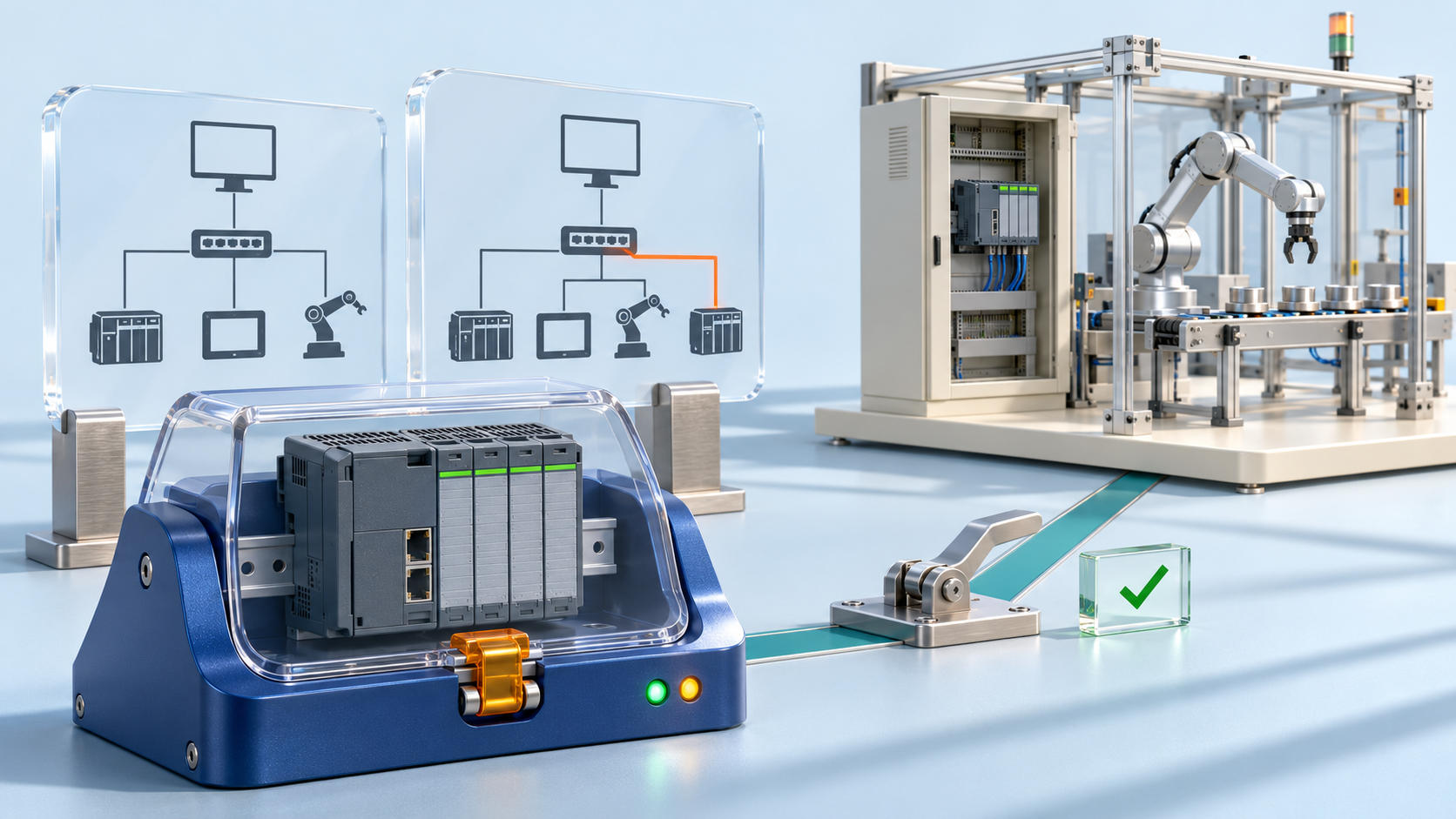
Management of change is one of the genuinely mature processes in industrial operations. Decades of process safety practice built it, regulators expect it, and most plants run it with real discipline. A change gets raised, assessed for its effect on the process, reviewed by the right disciplines and approved before anyone touches anything.
Then someone updates the firmware on a controller and none of that happens, because firmware does not look like a change to the process. The MOC form asks whether the modification affects the hazard, the protective function, the operating envelope. It does not ask whether the new version introduces a vulnerability, whether it invalidates your configuration baseline, or whether the technician will bring it in on a USB drive. Cybersecurity sits outside a process that was built before it mattered.
Three change types that slip through
|
Change type |
Why MOC usually misses it |
|
Firmware and software updates |
Treated as maintenance rather than modification, because the process logic is unchanged. But the attack surface, the configuration baseline and sometimes the supported-version position all change. |
|
Like-for-like equipment replacement |
A failed device replaced with the current model is functionally equivalent and frequently not identical. New firmware, new default settings, sometimes new network capability the old unit did not have. |
|
New network connections |
A cellular modem on a remote asset, a vendor diagnostic link, a historian feed to a cloud platform. None of these alters the process, and each alters who can reach it. |
The third is the most consequential and the least likely to reach an MOC form at all, because it is often seen as an IT activity happening near OT rather than a change to the control system.
|
The question that catches all three Does this change alter what can reach this system, or what this system can reach? Add that single question to your existing MOC form and you catch firmware that opens a service, a replacement unit with a network port the old one lacked, and every new connection. It requires no new process, no new committee and no new software, which is why it is the change most likely to actually happen. |
The cyber checks worth adding
- Does this change what can reach the system, or what it can reach? The question above. Make it mandatory, not optional.
- Is the new version or device supported, and for how long? A replacement that is already near end of support creates a legacy equipment problem you will inherit.
- Are default credentials and default services being changed before commissioning? A like-for-like replacement commonly arrives at factory defaults. See our OT hardening checklist.
- How is the software or firmware reaching the device? If the answer is removable media, the controls in our removable media security guide apply to this change.
- Is a known-good copy of the configuration taken before and after? Without the before, you cannot roll back. Without the after, your baseline is stale and you lose the ability to detect unauthorized change.
- Does the asset inventory get updated? Firmware versions are inventory data. A change that does not update the record degrades every downstream control. See our asset inventory guide.
- Who performs the security review, and is it recorded? If nobody is named, it is not happening.
Where safety review and security review meet
Industrial MOC already includes a safety review for anything touching a protective function, and that is the natural insertion point for the security question rather than a parallel process. A change to a safety instrumented system raises both questions simultaneously: does this affect the safety function, and does this affect who can alter the safety function. Those are genuinely different questions with potentially different answers, and asking only the first is how a security-relevant change to a protective system passes review.
This is the point where IEC 61511 and IEC 62443 meet, and it is the strongest argument for the two disciplines sharing a review rather than running separately. A safety engineer who does not know a controller is now internet-reachable cannot assess the safety case properly, and a security engineer who does not know a change affects a protective function cannot assess the consequence of their recommendation.
Making it workable rather than bureaucratic
The failure mode for this is obvious and common: a new cybersecurity MOC form nobody completes, running alongside the real MOC form everyone does complete. Three things avoid it.
Extend the existing form rather than creating a second one. A handful of additional fields on a process people already follow outperforms a parallel process with better questions. Tier the depth so a firmware update on a non-critical utility does not require the same review as a new connection into a control zone, because a process that treats both identically gets routed around for the trivial case and then for the significant one. And name the reviewer by role rather than by individual, so the check survives that person changing jobs.
Our guide to OT patch management covers the execution side of firmware changes once they have passed review, and control system integrity covers detecting change that bypassed the process entirely.
Why Choose Arista Cyber
We extend existing MOC processes rather than replacing them, because a security process that competes with process safety loses. Our consultants hold functional safety credentials alongside OT security certification, which means we can sit in a combined safety and security review and assess both sides rather than only one. See our OT cybersecurity services, our functional safety services and our case studies.
Next Steps
Pull your last ten completed MOC records and check how many involved a firmware update, an equipment replacement or a new connection. Then check how many recorded a security review. The gap between those two numbers is the case for the change, and it is usually persuasive without further argument.
Common Questions
Should cybersecurity be a separate MOC process?
No. Extend the existing process. A parallel cybersecurity MOC form competes with a mature process people already follow and tends to be bypassed, particularly for the small changes where the exposure often enters.
Why does firmware updating escape management of change?
Because it is treated as maintenance rather than modification. The process logic is unchanged, so the form appears not to apply, even though the attack surface, the configuration baseline and the supported-version position may all have changed.
Is a like-for-like replacement really a change?
Usually yes, in security terms. Functionally equivalent rarely means identical. Replacement units commonly arrive with newer firmware, factory default credentials and occasionally network capability the original did not have.
What single question should we add to the MOC form?
Does this change alter what can reach this system, or what this system can reach? It catches firmware that opens a service, replacement units with new connectivity, and every new network connection.
Who should perform the security review?
Name a role rather than an individual so the check survives staff changes. Where the change touches a protective function, the security review should sit alongside the existing safety review rather than in a separate workflow.
|
How many of your last ten changes had a security review? Arista Cyber extends existing management of change processes to cover cybersecurity, with tiered review depth and combined safety and security assessment where protective functions are affected. |
Facing tougher cyber security challenges?
Talk to Arista Cyber about your OT security posture.
Request a consultation