USB Security in OT: Which Controls Work and Which Get Bypassed

Removable media remains one of the most reliable ways into an industrial control network, for a reason that has nothing to do with technology. The path exists because people need it. A vendor arrives with firmware on a USB drive. An engineer needs a configuration file off a machine with no network connection. A contractor brings a laptop and a stick because that is how the job has always been done.
Every plant knows this. Most plants have bought a control for it. And in a large share of the assessments we run, the control is being worked around rather than used. This article is about which controls hold up in a working plant and which get bypassed, which is a different question from which is technically strongest. Our complete guide to removable media security for OT covers the fundamentals; this one covers the selection decision.
|
Disclosure, because this is a buying question Arista Cyber supplies a removable media security product alongside our consulting work. We say so here rather than presenting this as a neutral market survey, because a vendor writing a buyer's guide without disclosing that is not giving you advice. What follows is how we assess these controls on real sites, including where our own category of product is the wrong answer. |
The five control types, and how each actually fares
|
Control |
What it does |
How it fares in practice |
|
Policy alone |
States that USB use is prohibited or restricted. |
Fails on its own. A policy with no enforcement and no sanctioned alternative tells people to break the rule quietly rather than openly. |
|
Physical port blocking |
Locks or removes USB ports on critical assets. |
Effective where the asset genuinely never needs media, and that is a narrower set than people assume. Blocked ports get unblocked during commissioning and outages. |
|
Endpoint device control |
Software allowlisting of permitted devices and blocking of everything else. |
Strong on modern Windows assets. Unavailable on the legacy and embedded systems where the risk often concentrates. |
|
Scanning station or kiosk |
A dedicated station scans media before it enters the plant. |
The most commonly deployed and the most commonly bypassed. See below. |
|
One-way transfer |
Hardware-enforced transfer that removes the need for media to cross a boundary at all. |
Strongest where the requirement is moving data out. Does not address media going in. |
|
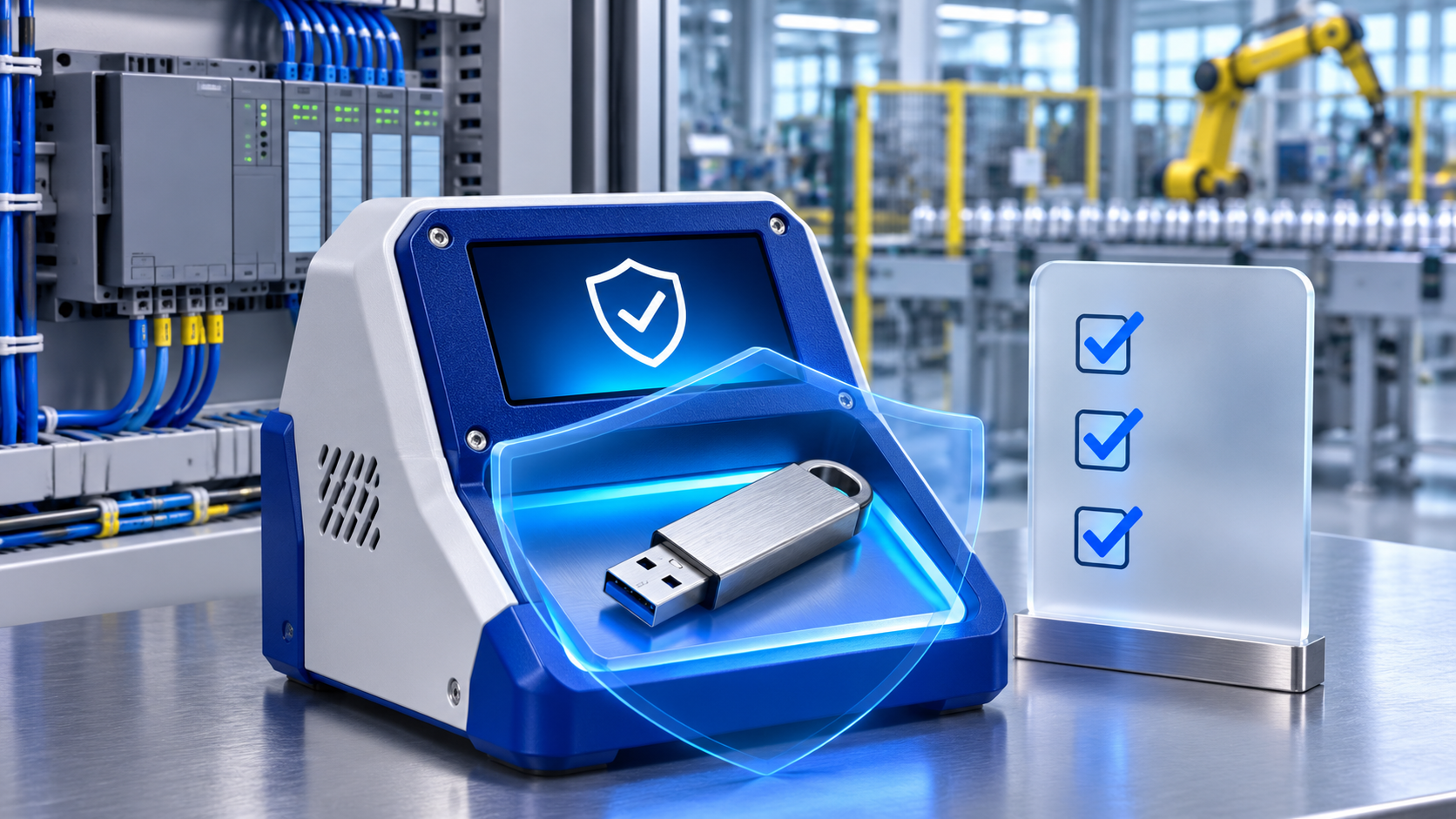
The kiosk is not the control. The process around it is. Scanning stations fail predictably and the failures are organizational, not technical. The kiosk sits in the admin building and the work is at the far end of the plant, so a twenty-minute round trip competes with a job someone wants finished. It cannot read the proprietary format the vendor tool uses, so an exception becomes routine. It is down and nobody owns it, so people route around it and the habit survives the repair. Or the scan passes clean media and nothing records that it ran, so there is no evidence a control exists at all. If you have a kiosk, the question to ask is not whether it works. It is how many media transfers last month went through it, and whether you can tell. |
Choose by what the media is actually for
Most plants treat removable media as one problem. It is three, and they call for different controls.
- Data coming out. Historian extracts, logs, reports going to the enterprise. This should not require media at all, and it is the clearest case for one-way transfer. Removing the need for the drive beats controlling the drive.
- Files going in, routinely. Recipes, configuration, updates. This is where a scanning and sanitization workflow belongs, and where the process design matters more than the product.
- Vendor and contractor media, occasionally. The highest risk and the least predictable. The control here is as much procedural as technical: a known arrival process, a station on their route rather than across the site, and a sanctioned alternative so the answer is not simply no.
Separating these three usually shrinks the problem. Plants that move the outbound case to one-way transfer find their remaining media volume drops enough that a stricter inbound process becomes workable.
What makes a control stick
- It is on the path people already walk. A station at the gate or the control room entrance gets used. One in a building nobody passes does not.
- It handles the formats you actually receive. Test it with a vendor firmware package before you buy, not after.
- It produces a record. A scan with no log is a control you cannot evidence, and evidence is half of what an auditor wants. See our OT hardening checklist.
- It has an owner. An unowned kiosk is out of service within a year.
- There is a sanctioned way to say yes. A control with no exception path generates undocumented exceptions. One with a defined fast route generates documented ones.
Where legacy equipment changes the answer
On a modern Windows engineering workstation, endpoint device control is the straightforward answer. On the equipment where removable media risk concentrates, it is frequently unavailable: unsupported operating systems that cannot run the agent, embedded HMIs with no software control at all, and controllers whose only configuration path is a vendor tool on a specific machine.
For those assets the control set narrows to physical and procedural measures, and the honest sequence is port blocking where the asset truly does not need media, a scanning requirement enforced at the point of use rather than centrally, and network position so that a compromise of that machine is contained. Our guidance on OT patch management covers the wider problem of equipment you cannot change.
A question worth asking before you buy anything
How many removable media transfers happened in your plant last month, and how many of them you can account for. Almost nobody can answer. If the number is unknown, buying a control is buying into an assumption about volume, locations and formats that may be wrong, and the most common outcome is a well-specified product in the wrong place.
A short observation period before procurement changes what you buy. It is also the cheapest part of the whole exercise.
Why Choose Arista Cyber
We assess how media actually moves through a plant before recommending a control, and we supply removable media security and data diode appliances where they are the right answer. We will also tell you when the fix is moving a station a hundred feet or assigning an owner, neither of which we sell. Our consultants hold functional safety credentials alongside OT security certification and work on live industrial assets. See our case studies and our OT cybersecurity services.
Next Steps
Count the transfers before you specify the control. A few weeks of observation tells you the volume, the locations and the formats, and those three facts determine whether you need a product, a process change, or both.
Common Questions
What is the best removable media control for an industrial plant?
There is no single answer, because the right control depends on whether media is carrying data out, bringing files in routinely, or arriving with a vendor. Outbound transfer is usually best solved by removing the need for media. Routine inbound suits a scanning workflow. Vendor media is as much a procedural problem as a technical one.
Why do USB scanning kiosks get bypassed?
Almost always for organizational reasons rather than technical ones: the station is too far from where the work happens, it cannot read a format the vendor uses, it is out of service with no owner, or using it produces no record so nobody can tell whether it was used.
Can we just block all USB ports?
On assets that genuinely never need media, yes, and it is effective. The set of such assets is smaller than most plants assume, and blocked ports tend to be unblocked during commissioning and outages and not restored.
Does endpoint device control work in OT?
On modern Windows assets, well. On the legacy and embedded equipment where the risk often concentrates it is frequently unavailable, which is why physical and procedural controls carry more weight in industrial environments than in IT.
How does a data diode relate to removable media?
It addresses the outbound case. Where media is used to carry data from the plant to the enterprise, one-way transfer removes the reason for the drive to exist. It does not address media coming in.
What should we do before buying a removable media product?
Measure. Count the transfers, the locations and the formats over a few weeks. Procurement without that data usually produces a well-specified product installed where nobody will walk to it.
|
How many media transfers happened in your plant last month? Arista Cyber assesses how removable media actually moves through industrial sites, then specifies the control set that fits the volume, the locations and the formats you really handle. |
Facing tougher cyber security challenges?
Talk to Arista Cyber about your OT security posture.
Request a consultation